Mystery Technique

Mystery Technique #59

image1


I have a new favorite tool, and this is my first experiment with it; want to know what it is? Watch for the surprising answer in June!


ANSWER TO MYSTERY TECHNIQUE #58:

This is part of a painting test I did for a flexicube called Six Sides of Science. The patterns of lines on each side were inspired by the veins and arteries in old medical diagrams, and 2 of my line-making tools are pictured below: my favorite liner brush (brand unknown) and a Fluid Writer (by Kemper). I used diluted layers of acrylic inks and Hydrus liquid watercolors with Granulation Medium for the background colors; then I drew some of the lines with water only before adding diluted acrylic for the veins.


IMG_1382


Here are 2 views of the completed flexicube, which won a Purchase Award several years ago.


Six Sides of Science, 4 x 8.5 x 2 in, watermedia, ©2012 Elizabeth Sanford


Six Sides of Science, 4 x 8.5 x 2 in, watermedia, ©2012 Elizabeth Sanford

Mystery Technique

Mystery Technique #58

MT #58, ©Elizabeth Sanford


Curious to know more about how this was done? You can find out about the special tools I used if you’ve signed up for email updates; I’ll reveal the details in May!


ANSWER TO MYSTERY TECHNIQUE #57:

This is the page I contributed for a special artist book that Watkins College gave Mayor Barry last spring. Each page celebrates a Nashville landmark, and I chose Warner Parks, which I started visiting as a child – it’s still one of my favorite places! I wanted the background to create the impression of light coming through spring foliage, so I began with a yellow underpainting and left a few bits of white paper. After the first layer dried, I layered greens and blue-greens and added a little spattering. I used  a craft knife to cut the sphinx moth out of black exhibition vinyl and put the title in its wings.

Mystery Technique

Mystery Technique #57

MT#57, ©2016 Elizabeth Sanford


This Mystery Technique belongs to the mayor of Nashville! Curious to know more? You can find out the rest of the story in April if you’ve signed up for email updates!


ANSWER TO MYSTERY TECHNIQUE #56, Parts 1 and 2:

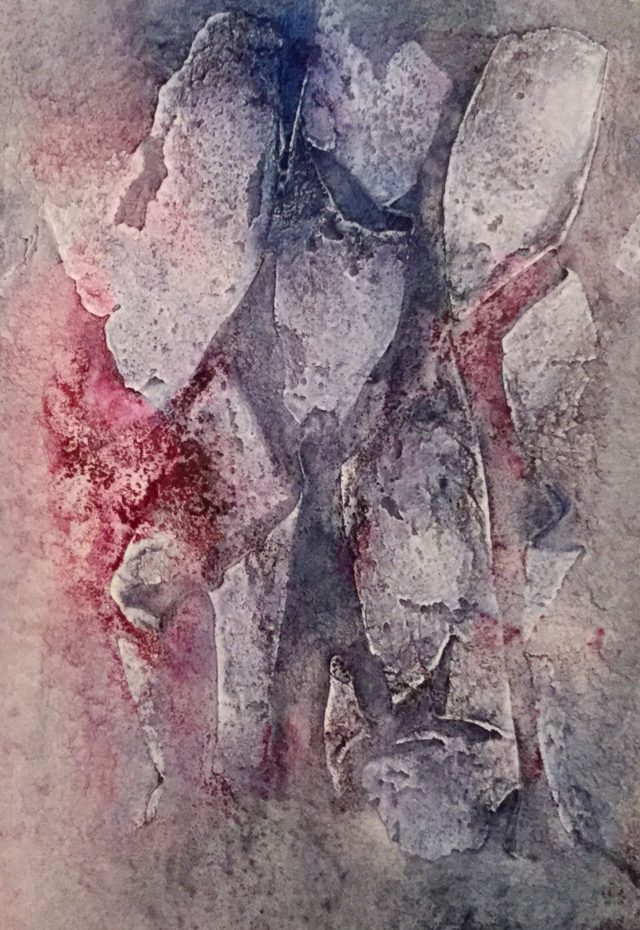
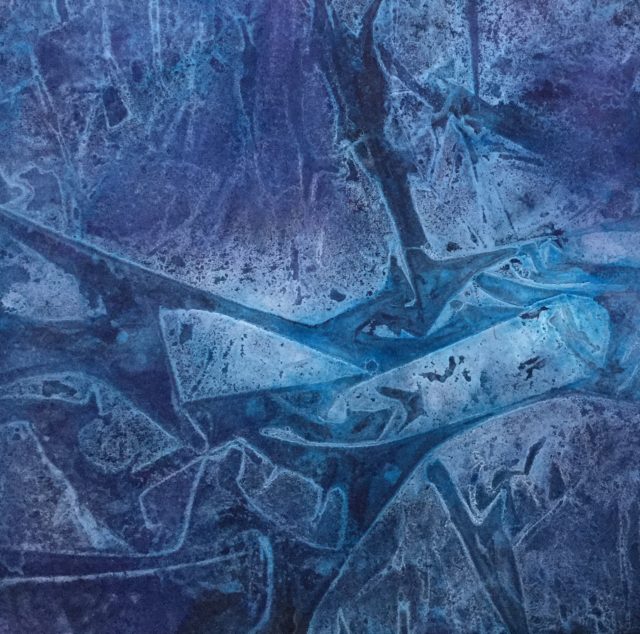
The paper makes such a difference in watercolor! I began both Parts by wetting the paper, then mixed Daniel Smith’s Hematite Genuine, Hematite Burnt Scarlet Genuine,  Sodalite Genuine, Dr. Ph. Martin’s HYDRUS Permanent Red, and Winsor & Newton’s Granulation Medium right on the surface of the paper. While the paper was still wet, I applied pieces of thin recycled plastic, then experimented with a variety of tools to make linear patterns; I also emphasized some of the shapes by injecting additional liquid paint under the plastic and applied weight in a few spots to vary the effects. After all the liquid evaporated, I removed the plastic. The visual textures are definitely more dramatic on the hot press (Part 1) than the rough (Part 2)!